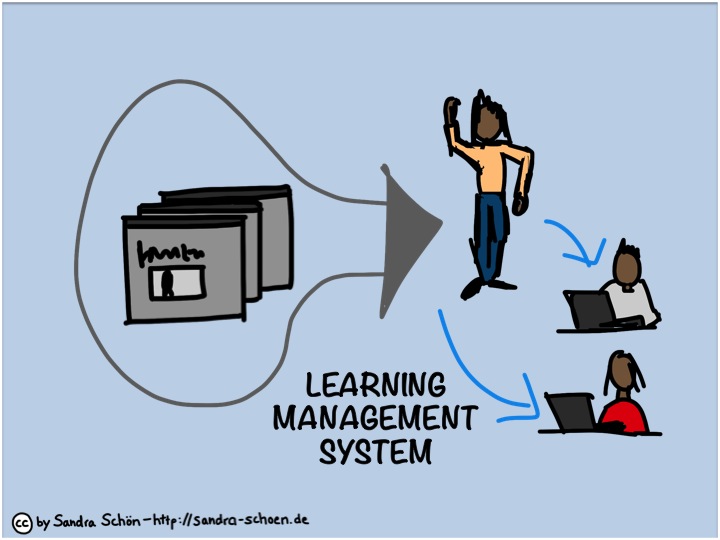
The question of which learning management system to deploy is rarely purely technical. In Polish public education it involves budget constraints set by the organ prowadzący (typically the municipality), data protection obligations under GDPR, integration requirements with the national e-dziennik (electronic class register) system, and the practical reality of what teachers can learn without extended professional development time.
This article maps four platforms that appear consistently in Polish school and university deployments and examines them on the criteria that matter most for institutional decision-making.
Moodle
Moodle is an open-source LMS maintained by Moodle HQ and a global community of developers. In Poland it has historically been stronger in higher education and vocational training than in the primary and secondary sector, because self-hosting demands server infrastructure and technical staff that most schools do not have.
- Cost: The software itself is free. Hosting, maintenance and plugin development are additional costs. Moodle's MoodleCloud offers hosted plans from a monthly fee, but data residency varies by plan.
- GDPR: When self-hosted on infrastructure within the EU (or a verified EU-adequate jurisdiction), Moodle gives institutions full control over data. This is its main advantage over cloud-first platforms for schools handling minors' data under Polish RODO obligations.
- Language support: Full Polish-language interface available. The pl language pack is actively maintained.
- E-dziennik integration: No native integration with Vulcan or Librus. Schools using Moodle alongside an e-dziennik system maintain two parallel records, which creates administrative overhead.
- Practical assessment: Best suited to vocational schools and universities with technical staff. Overkill for most primary schools; viable for larger secondary schools with a designated IT coordinator.
Microsoft Teams for Education
Teams for Education is included in the Microsoft 365 A1 licence, which Microsoft makes available at no charge to accredited educational institutions. This has made it the default choice for a large number of Polish schools between 2020 and 2025, partly because the licence was straightforward to obtain and partly because many schools already had Microsoft infrastructure.
- Cost: Microsoft 365 A1 is free for schools. A1 Plus and A3 tiers add features including Teams Essentials live event capacity and advanced analytics, at a cost.
- GDPR: Microsoft publishes a GDPR-compliant Data Processing Agreement for Education customers. EU data residency is available. The school must configure data location settings correctly — it is not automatic.
- Language support: Full Polish interface. Polish is one of the primary languages in Microsoft's enterprise software stack.
- E-dziennik integration: No native integration with Vulcan or Librus. The gradebook in Teams Assignments is separate from the official class register. Schools typically manage this by exporting grades manually at reporting periods.
- Practical assessment: Strongest for schools already in the Microsoft ecosystem. The interface is not designed for young children and can be overwhelming at primary level. Widely used at secondary and tertiary level with generally positive teacher feedback on video conferencing quality.
The most common failure point in LMS adoption is not the platform — it is the absence of a school-wide agreement on which features will be used and which will not. Schools that restricted their Teams use to three functions (assignments, video calls, file sharing) had fewer problems than those that tried to use every feature from the start.
Google Classroom
Google Classroom, part of Google Workspace for Education Fundamentals, is also available free to educational institutions. Its interface is significantly simpler than Teams, which has made it more popular in primary schools where ease of student navigation matters more than feature depth.
- Cost: Workspace for Education Fundamentals is free. Teaching and Learning Upgrade and Education Plus tiers carry per-user monthly costs and add features like originality reports (plagiarism checking), advanced Meet functionality and device management.
- GDPR: Google's Data Processing Amendment for Google Workspace for Education is GDPR-compliant. EU data processing is available. As with Microsoft, correct configuration is required. Schools should verify that student accounts do not sync data to consumer Google services.
- Language support: Full Polish interface.
- E-dziennik integration: No native integration. Grades exported manually.
- Practical assessment: The cleanest interface for students. Integration with Google Docs supports collaborative writing and teacher annotation. Weaker than Teams for video conferencing at scale. Preferred by many primary school teachers for its simplicity.

Edubox (formerly EduSense)
Edubox is a Polish-developed LMS produced by a Wrocław-based company. It occupies a different market segment from the three global platforms: it is designed specifically for Polish educational requirements, including native integration with the Vulcan e-dziennik system.
- Cost: Subscription-based, per-student pricing. Costs are negotiated at district level and are not published publicly. Schools report costs in the range of a few hundred złoty per month for medium-sized institutions.
- GDPR: Data processed on Polish/EU servers. The company holds ISO 27001 certification. This is its strongest differentiator versus international platforms for compliance-focused institutions.
- Language support: Polish only (by design).
- E-dziennik integration: Native two-way sync with Vulcan. Grades entered in Edubox appear automatically in the official register. This eliminates the manual export step that all other platforms require.
- Practical assessment: The e-dziennik integration is a genuine operational advantage for schools that find double-entry of grades burdensome. The platform is less feature-rich than Moodle and less familiar to teachers who trained on Microsoft or Google tools.
How to choose
The decision matrix is roughly as follows. Schools with existing Microsoft 365 licences and adequate teacher familiarity with Microsoft products will find Teams the path of least resistance. Schools with younger students and no prior platform commitment often find Google Classroom's simplicity reduces adoption friction. Schools for which Vulcan integration is a hard requirement should evaluate Edubox. Schools with technical capacity and a need for full data control should consider Moodle hosted within EU infrastructure.
No platform eliminates the need for clear internal policy on what will be assigned digitally, how students will submit work, and how grades will be communicated to parents. The platform is infrastructure; the pedagogy remains the school's responsibility.